Enterprise Java Development@TOPIC@
Mapping Entity Inheritance to the Database
Built on: 2014-03-07 00:07 EST
Copyright © 2014 jim stafford (jcstaff@apl.jhu.edu)
Abstract
This presentation provides information for mapping Java entity class inheritance to the database using JPA.
At the completion of this topic, the student shall
have an understanding of:
Inheritance strategies
Single Table
Table per Concrete Class
Joined
Mapped Superclass for non-entity parent classes
be able to:
Be able to map a Java inheritance relationship using a Single Table strategy
Be able to map a Java inheritance relationship using a Table per Concrete Class strategy
Be able to map a Java inheritance relationship using a Table per Subclass (Join) strategy
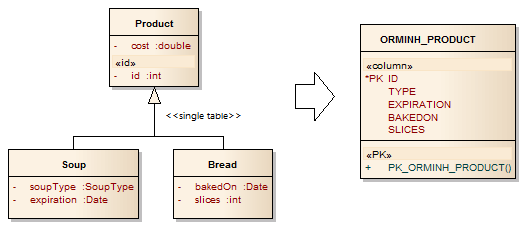
Advantages
Simplest to implement
Single table to administer
Performs better than other inheritance strategies
No complex joins
Disadvantages
Unused fields when sub-types have unique properties
Sub-type columns must be nullable
Harder to enforce constraints within database
SQL "check" constraint can help
check(TYPE != 'BREAD_TYPE' or (BAKEDON is not null and SLICES is not null))
check(TYPE != 'Soup' or (SOUPTYPE is not null and EXPIRATION is not null)
Not normalized
More suitable for hierarchies with sub-types that...
Differ primarily in behavior only
Do not have unique data requirements
Figure 1.2. Single Table Example Database Schema
create table ORMINH_PRODUCT (
    PTYPE varchar(32) not null,
    id bigint generated by default as identity,
    cost double not null,
    expiration date,
    SOUPTYPE varchar(16),
    bakedOn date,
    slices integer,
    primary key (id)
)
Single table
No joins
Unused columns
Figure 1.3. Single Table Example Java Mapping (Parent Class)
@Entity @Table(name="ORMINH_PRODUCT")

@Inheritance(strategy=InheritanceType.SINGLE_TABLE)

@DiscriminatorColumn(name="PTYPE", //column in root table indicating type

    discriminatorType=DiscriminatorType.STRING,//data type of column

    length=32) //length of discriminator string

public abstract class Product {

    @Id @GeneratedValue

    private long id;

    private double cost;

...

    @Transient

    public abstract String getName();
Parent defines default mapping for all derived types
Figure 1.4. Single Table Example Java Mapping (Annotated Derived)
@Entity

@DiscriminatorValue("BREAD_TYPE") //value placed in root table to indicate type

public class Bread extends Product {

    private int slices;

    @Temporal(TemporalType.DATE)

    private Date bakedOn;

...

    @Transient

    public String getName() { return "Bread"; }
Supplies type-specific column value
Figure 1.5. Single Table Example Java Mapping (Default Derived)
@Entity

public class Soup extends Product {

    public enum SoupType {

        UNKNOWN("Unknown"),

        CHICKEN_NOODLE("Chicken Noodle"),

        NEW_ENGLAND_CLAM_CHOWDER("New England Clam Chowder"),

        TOMATO("Tomato");

        private String text;

        private SoupType(String text) { this.text = text; }

        public String text() { return text; }

    };


    @Enumerated(EnumType.STRING)

    @Column(name="SOUPTYPE", length=16)

    private SoupType type = SoupType.UNKNOWN;

    @Temporal(TemporalType.DATE)

    private Date expiration;

...

    @Transient

    public String getName() { return type.text() + "Soup"; }
Accepts default type-specific column value
Figure 1.6. Single Table Example Usage (Persist)
ejava.examples.orm.inheritance.annotated.Soup soup = new Soup();

soup.setCost(2.12);

final long lifetime = 365L*24*60*60*1000;

soup.setExpiration(new Date(System.currentTimeMillis() + lifetime));

soup.setSoupType(Soup.SoupType.CHICKEN_NOODLE);

em.persist(soup);


ejava.examples.orm.inheritance.annotated.Bread bread = new Bread();

bread.setBakedOn(new Date());

bread.setCost(2.25);

bread.setSlices(24);

em.persist(bread);
Hibernate:
    insert into ORMINH_PRODUCT (id, cost, expiration, SOUPTYPE, PTYPE)
    values (null, ?, ?, ?, 'Soup')
Hibernate:
    insert into ORMINH_PRODUCT(id, cost, bakedOn, slices, PTYPE)
    values (null, ?, ?, ?, 'BREAD_TYPE')
Two rows inserted into single base table with discriminator type supplied
Figure 1.7. Single Table Example Usage (Get Entities)
List<Product> products = em.createQuery(

    "select p from Product p", Product.class)

    .getResultList();

assertTrue("unexpected number of products:" + products.size(),

        products.size() == 2);

for(Product p: products) {

    log.info("product found:" + p);

}
Hibernate:
select
    product0_.id as id2_9_,
    product0_.cost as cost3_9_,
    product0_.expiration as expirati4_9_,
    product0_.SOUPTYPE as SOUPTYPE5_9_,
    product0_.bakedOn as bakedOn6_9_,
    product0_.slices as slices7_9_,
    product0_.PTYPE as PTYPE1_9_
from
    ORMINH_PRODUCT product0_
-product found:Soup, id=1, cost=2.12, type=CHICKEN_NOODLE, expiration=2014-10-05
-product found:Bread, id=2, cost=2.25, slices=24, baked=2013-10-05
Single table queried for objects
Figure 1.8. Single Table Example Usage (Verify DB Schema)
//query specific tables for columns

int rows = em.createNativeQuery(

        "select ID, TYPE, COST, SOUPTYPE, EXPIRATION, BAKEDON, SLICES " +

        " from ORMINH_PRODUCT")

        .getResultList().size();

assertEquals("unexpected number of product rows:" + rows, 2, rows);
select * from ORMINH_PRODUCT
PTYPE      ID COST BAKEDON    SLICES EXPIRATION SOUPTYPE
---------- -- ---- ---------- ------ ---------- --------------
Soup       1  2.12 (null)     (null) 2007-10-08 CHICKEN_NOODLE
BREAD_TYPE 2  2.25 2006-10-08 24     (null)     (null)
Single table "sparsely" filled based on type
@DiscriminatorColumn defines column to hold type-specific value
name (default="DTYPE")Column name
discriminatorTypeSTRING (defaults to Entity.name)Only portable technique when accepting default
CHARVendor-specific value when accepting default
INTEGERVendor-specific value when accepting default
columnDefinitionDatabase-specific definition for when generating schema
lengthSize of STRING
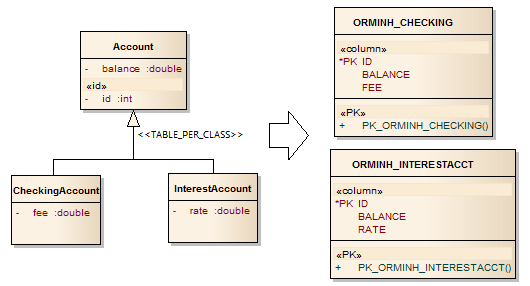
Advantages
May have constrained columns
No joins when accessing a single concrete type
Disadvantages
Not normalized
Redundant columns in each concrete child table
More work required to query across tables
Requires use of SQL "UNION"
Least desirable from a performance/portability standpoint
More suitable for ...
Sub-types not needed to be manipulated with sibling other sub-types
Figure 2.2. Table per Concrete Class Example Database Schema
create table ORMINH_CHECKING (
    id bigint not null,
    balance double not null,
    fee double not null,
    primary key (id)
)
create table ORMINH_INTERESTACCT (
    id bigint not null,
    balance double not null,
    rate double not null,
    primary key (id)
)
create sequence ORMINH_SEQ
Table for each concrete class
No separate table for parent class
Parent columns repeated in concrete sub-class tables
* his particular example uses SEQUENCE for primary key generation
Figure 2.3. Table per Concrete Class Example Java Mapping (Parent Class)
@Entity

@Inheritance(strategy=InheritanceType.TABLE_PER_CLASS)

@SequenceGenerator(

        name="orminhSeq", //required logical name

        sequenceName="ORMINH_SEQ" //name in database

)

public abstract class Account {

    @Id @GeneratedValue(strategy=GenerationType.SEQUENCE, generator="orminhSeq")

    private long id;

    private double balance;

...

    public void deposit(double amount) throws AccountException {

        setBalance(getBalance() + amount);

    }

    public abstract void withdraw(double amount) throws AccountException;

...
Parent defines default mapping for all derived types, including PK generation
Using a common SEQUENCE allows sub-classes to have unique PKs across all tables
Figure 2.4. Table per Concrete Class Example Java Mapping (Subclasses)
@Entity

@Table(name="ORMINH_CHECKING")

public class CheckingAccount extends Account {

    private double fee;


    public void withdraw(double amount) throws AccountException {

        super.setBalance(super.getBalance() - fee);

    }
@Entity

@Table(name="ORMINH_INTERESTACCT")

public class InterestAccount extends Account {

    private double rate;


    public void withdraw(double amount) throws AccountException {

        super.setBalance(super.getBalance() - amount);

    }
Subclasses name their specific entity class table
Figure 2.5. Table per Concrete Class Example Usage (Persist)
ejava.examples.orm.inheritance.annotated.CheckingAccount checking = new CheckingAccount();

checking.setFee(0.50);

em.persist(checking);


ejava.examples.orm.inheritance.annotated.InterestAccount savings = new InterestAccount();

savings.setRate(0.25);

em.persist(savings);
Hibernate:
    call next value for ORMINH_SEQ
Hibernate:
    insert into ORMINH_CHECKING (balance, fee, id)
    values (?, ?, ?)
Hibernate:
    insert into ORMINH_INTERESTACCT (balance, rate, id)
    values (?, ?, ?)
Rows for entities placed into separate tables
Figure 2.6. Table per Concrete Class Example Usage (Get Entities)
List<Account> accounts =em.createQuery("select a from Account a").getResultList();

assertTrue("unexpected number of accounts:" + accounts.size(), accounts.size() == 2);

for(Account a: accounts) {

    log.info("account found:" + a);

}
select
    account0_.id as id1_0_,
    account0_.balance as balance2_0_,
    account0_.rate as rate1_7_,
    account0_.fee as fee1_2_,
    account0_.clazz_ as clazz_
from (
    select id, balance, rate, null as fee, 1 as clazz_
    from ORMINH_INTERESTACCT

    union all

    select id, balance, null as rate, fee, 2 as clazz_
    from ORMINH_CHECKING
) account0_
-account found:InterestAccount, id=51, balance=0.0, rate=0.25
-account found:CheckingAccount, id=50, balance=0.0, fee=0.5
Query through parent type causes SQL "UNION ALL" of each concrete sub-class table
Figure 2.7. Table per Concrete Class Example Usage (Verify DB Schema)
//query specific tables for columns

int rows = em.createNativeQuery(

        "select ID, BALANCE, FEE from ORMINH_CHECKING")

        .getResultList().size();

assertEquals("unexpected number of checking rows:" + rows, 1, rows);

rows = em.createNativeQuery(

        "select ID, BALANCE, RATE from ORMINH_INTERESTACCT")

        .getResultList().size();

assertEquals("unexpected number of interestacct rows:" + rows, 1, rows);
select * from ORMINH_CHECKING
ID BALANCE FEE
-- ------- ---
50 0.0     0.5

select * from ORMINH_INTERESTACCT
ID BALANCE RATE
-- ------- ----
51 0.0     0.25
Table per concrete class
No unused columns
Parent columns repeated in each sub-class table
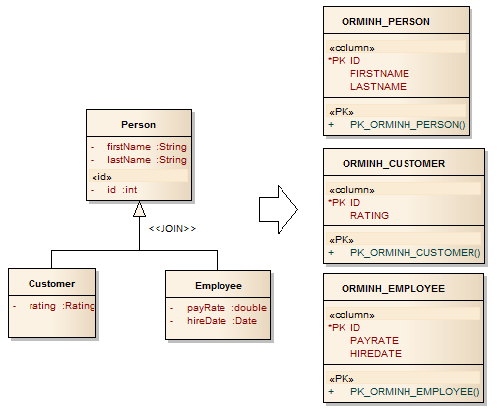
Advantages
Can be normalized
Permits constraints to be defined
Disadvantages
Requires access to multiple tables when using (insert, select, update, and delete) an entity
More suitable for sub-classes that...
Have many unique properties
Require database constraints
Are queried for across sibling sub-types
Figure 3.2. Join Example Database Schema
create table ORMINH_PERSON (
    id bigint generated by default as identity,
    firstName varchar(255),
    lastName varchar(255),
    primary key (id)
)
create table ORMINH_EMPLOYEE (
    hireDate date,
    payrate double not null,
    id bigint not null,
    primary key (id)
)
alter table ORMINH_CUSTOMER
    add constraint FK6D5464A42122B7AC
    foreign key (id)
    references ORMINH_PERSON
alter table ORMINH_EMPLOYEE
    add constraint FK9055CB742122B7AC
    foreign key (id)
    references ORMINH_PERSON
Table for each entity class is created
Each table has a primary key
Sub-class tables use a primary key join with parent class
Figure 3.3. Join Example Java Mapping (Parent Class)
@Entity @Table(name="ORMINH_PERSON")

@Inheritance(strategy=InheritanceType.JOINED)

public class Person {

    @Id @GeneratedValue

    private long id;

    private String firstName;

    private String lastName;
Parent defines default mapping for all derived types
Parent entity class table also defined
Figure 3.4. Join Example Java Mapping (Subclasses)
@Entity

@Table(name="ORMINH_CUSTOMER") //joined with Person table to form Customer

public class Customer extends Person {

    public enum Rating { GOLD, SILVER, BRONZE }

    @Enumerated(EnumType.STRING)

    private Rating rating;
@Entity

@Table(name="ORMINH_EMPLOYEE") //joined with Person table to form Employee

public class Employee extends Person {

    private double payrate;

    @Temporal(TemporalType.DATE)

    private Date hireDate;
Sub-classes define their entity-specific tables
Figure 3.5. Join Example Usage
ejava.examples.orm.inheritance.annotated.Employee employee = new Employee();

employee.setFirstName("john");

employee.setLastName("doe");

employee.setHireDate(new Date());

employee.setPayrate(10.00);

em.persist(employee);


ejava.examples.orm.inheritance.annotated.Customer customer = new Customer();

customer.setFirstName("jane");

customer.setLastName("johnson");

customer.setRating(Customer.Rating.SILVER);

em.persist(customer);
Hibernate:
    insert into ORMINH_PERSON (id, firstName, lastName)
    values (null, ?, ?)
Hibernate:
    insert into ORMINH_EMPLOYEE (hireDate, payrate, id)
    values (?, ?, ?)
Hibernate:
    insert into ORMINH_PERSON (id, firstName, lastName)
    values (null, ?, ?)
Hibernate:
    insert into ORMINH_CUSTOMER (rating, id)
    values (?, ?)
Each persist() must insert into concrete class table and parent class table(s)
Figure 3.6. Join Example Usage (Get Entities)
List<Person> people = em.createQuery("select p from Person p", Person.class).getResultList();

assertTrue("unexpected number of people:" + people.size(),

        people.size() == 2);

for(Person p: people) {

    log.info("person found:" + p);

}
select
    person0_.id as id1_8_,
    person0_.firstName as firstNam2_8_,
    person0_.lastName as lastName3_8_,
    person0_1_.hireDate as hireDate1_6_,
    person0_1_.payrate as payrate2_6_,
    person0_2_.rating as rating1_5_,
    case
        when person0_1_.id is not null then 1
        when person0_2_.id is not null then 2
        when person0_.id is not null then 0
    end as clazz_
from ORMINH_PERSON person0_
left outer join ORMINH_EMPLOYEE person0_1_
        on person0_.id=person0_1_.id
left outer join ORMINH_CUSTOMER person0_2_
        on person0_.id=person0_2_.id
-person found:Employee, id=1, firstName=john, lastName=doe, payrate=10.0
-person found:Customer, id=2, firstName=jane, lastName=johnson, rating=SILVER
Parent class table joined with each sub-class table during query of parent type
Figure 3.7. Join Example Usage (Verify DB Schema)
int rows = em.createNativeQuery(

        "select ID, FIRSTNAME, LASTNAME from ORMINH_PERSON")

        .getResultList().size();

assertEquals("unexpected number of person rows:" + rows, 2, rows);

rows = em.createNativeQuery(

        "select ID, RATING from ORMINH_CUSTOMER")

        .getResultList().size();

assertEquals("unexpected number of customer rows:" + rows, 1, rows);

rows = em.createNativeQuery(

        "select ID, PAYRATE, HIREDATE from ORMINH_EMPLOYEE")

        .getResultList().size();

assertEquals("unexpected number of employee rows:" + rows, 1, rows);
select * from ORMINH_PERSON
ID FIRSTNAME LASTNAME
-- --------- --------
1  john      doe
2  jane      johnson

select * from ORMINH_EMPLOYEE
ID HIREDATE   PAYRATE
-- ---------- -------
1  2006-10-08 10.0

select * from ORMINH_CUSTOMER
ID RATING
-- ------
2  SILVER
Entities span multiple tables
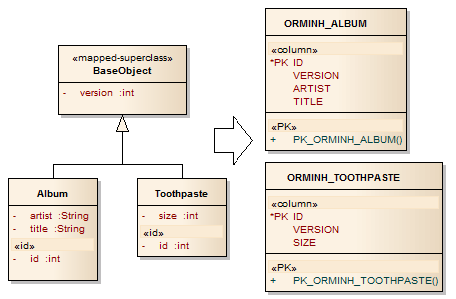
Advantages
Allows inheritance of non-entity classes
Disadvantages
No base entity to form queries across hierarchy (unlike TABLE_PER_CLASS)
Tables not normalized (like TABLE_PER_CLASS)
Parent columns repeated in each subclass table
More suitable for ...
Independent subclasses
Figure 4.2. Non-Entity Example Database Schema
create table ORMINH_ALBUM (
    ALBUM_ID bigint generated by default as identity,
    ALBUM_VERSION bigint,
    artist varchar(255),
    title varchar(255),
    primary key (ALBUM_ID)
)
create table ORMINH_TOOTHPASTE (
    id bigint generated by default as identity,
    version bigint not null,
    size integer not null,
    primary key (id)
)
Non-entity base class properties appear in subclass tables
Figure 4.3. Non-Entity Example Java Mapping (Parent Class)
@MappedSuperclass

public abstract class BaseObject {

    private long id;

    @Access(AccessType.FIELD)

    private long version;


    @Transient

    public long getId() { return id; }

    protected void setId(long id) {

        this.id = id;

    }
Parent class is not a legal entity -- has no @Id
Note
In this example, the implementation of BaseObject actually has an id attribute that the derived classes make use of. However, it is marked as @Transient in the base class and @Id in the derived Entity classes since MappedSuperClasses do not have primary keys. This specific example could have also used TABLE_PER_CLASS because of the availability of an id property in the base class.
Figure 4.4. Non-Entity Example Java Mapping (Override Defaults)
@Entity

@Table(name="ORMINH_ALBUM") //this table holds both this entity and parent class

@AttributeOverrides({

    @AttributeOverride(name="version", column=@Column(name="ALBUM_VERSION"))

})

public class Album extends BaseObject {

    @Access(AccessType.FIELD)

    private String artist;

    @Access(AccessType.FIELD)

    private String title;


    @Id @GeneratedValue //id is being generated independent of other siblings

    @Column(name="ALBUM_ID")

    public long getId() { return super.getId(); }

    protected void setId(long id) {

        super.setId(id);

    }
"version" column name from parent being renamed
"id" property defined in this class given custom column name
Transient attribute in parent being reused to hold @Id for subclass using PROPERTY access
Figure 4.5. Non-Entity Example Java Mapping (Default Derived)
@Entity

@Table(name="ORMINH_TOOTHPASTE") //table holds this entity and parent class

public class ToothPaste extends BaseObject {

    @Access(AccessType.FIELD)

    private int size;


    @Id @GeneratedValue //id is being generated independent of other siblings

    public long getId() { return super.getId(); }

    protected void setId(long id) {

        super.setId(id);

    }
Entity accepts mapping defaults
Figure 4.6. Non-Entity Example Usage
ejava.examples.orm.inheritance.annotated.Album album = new Album();

album.setArtist("Lynyrd Skynyrd");

album.setTitle("One More for the Road");

em.persist(album);


ejava.examples.orm.inheritance.annotated.ToothPaste toothpaste = new ToothPaste();

toothpaste.setSize(10);

em.persist(toothpaste);
Hibernate:
    insert into ORMINH_ALBUM (ALBUM_ID, ALBUM_VERSION, artist, title)
    values (null, ?, ?, ?)
Hibernate:
    insert into ORMINH_TOOTHPASTE (id, version, size)
    values (null, ?, ?)
Rows are inserted into type-specific entity class tables
Figure 4.7. Non-Entity Example Usage (Get Entities)
List<BaseObject> objects = em.createQuery("select a from Album a").getResultList();

objects.addAll( em.createQuery("select tp from ToothPaste tp").getResultList());


assertTrue("unexpected number of objects:" + objects.size(), objects.size() == 2);

for(BaseObject o: objects) {

    log.info("object found:" + o);

}
Hibernate:
    select
        album0_.ALBUM_ID as ALBUM1_1_,
        album0_.ALBUM_VERSION as ALBUM2_1_,
        album0_.artist as artist3_1_,
        album0_.title as title4_1_
    from ORMINH_ALBUM album0_
Hibernate:
    select
        toothpaste0_.id as id1_12_,
        toothpaste0_.version as version2_12_,
        toothpaste0_.size as size3_12_
    from ORMINH_TOOTHPASTE toothpaste0_
-object found:ejava.examples.orm.inheritance.annotated.Album@3822f407, id=1, name=Lynyrd Skynyrd:One More for the Road
-object found:ejava.examples.orm.inheritance.annotated.ToothPaste@22a79bc, id=1, name=10oz toothpaste
Separate tables are accessed when obtaining each type
Figure 4.8. Non-Entity Example Usage (Verify DB Schema)
int rows = em.createNativeQuery(

        "select ALBUM_ID, ALBUM_VERSION, ARTIST, TITLE " +

        " from ORMINH_ALBUM")

        .getResultList().size();

assertEquals("unexpected number of album rows:" + rows, 1, rows);

rows = em.createNativeQuery(

        "select ID, VERSION, SIZE " +

        " from ORMINH_TOOTHPASTE")

        .getResultList().size();

assertEquals("unexpected number of toothpaste rows:" + rows, 1, rows);
select * from ORMINH_ALBUM
ALBUM_ID ALBUM_VERSION ARTIST         TITLE
-------- ------------- -------------- ---------------------
1        0             Lynyrd Skynyrd One More for the Road

select * from ORMINHTOOTHPASTE
ID VERSION SIZE
-- ------- ----
1  0       10
Separate tables per concrete class (like TABLE_PER_CLASS)
No unused columns (like TABLE_PER_CLASS)
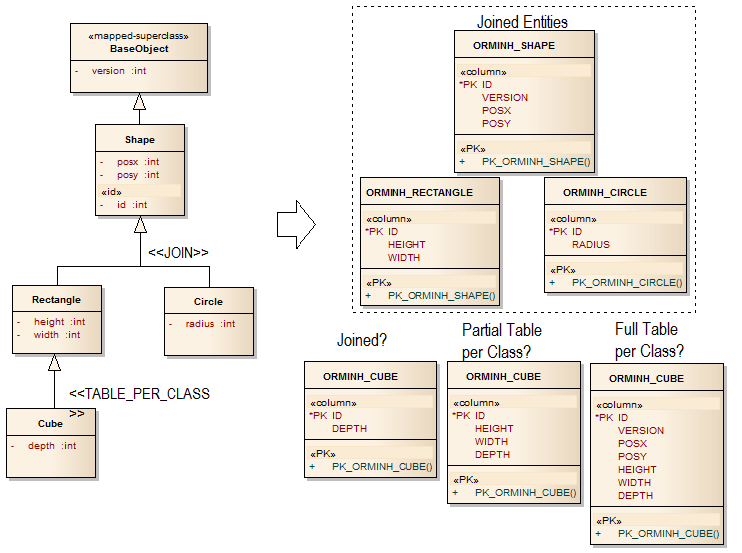
Figure 5.2. Generated Database Schema
create table ORMINH_SHAPE (
    id bigint generated by default as identity,
    version bigint not null,
    posx integer not null,
    posy integer not null,
    primary key (id)
)
create table ORMINH_CIRCLE (
    radius integer not null,
    id bigint not null,
    primary key (id)
)
create table ORMINH_RECTANGLE (
    height integer not null,
    width integer not null,
    id bigint not null,
    primary key (id)
)
alter table ORMINH_CIRCLE
    add constraint FKFF2F1F1632C97600
    foreign key (id)
    references ORMINH_SHAPE
alter table ORMINH_RECTANGLE
    add constraint FK1FFF614932C97600
    foreign key (id)
    references ORMINH_SHAPE
create table ORMINH_CUBE (
depth integer not null,
id bigint not null,
primary key (id)
)
alter table ORMINH_CUBE
add constraint FK84203FB112391CE
foreign key (id)
references ORMINH_RECTANGLEProvider used parent's JOIN strategy over child's TABLE_PER_CLASS specification